Week 3 — ITIL 4: Service Value Chain & SVS in Action
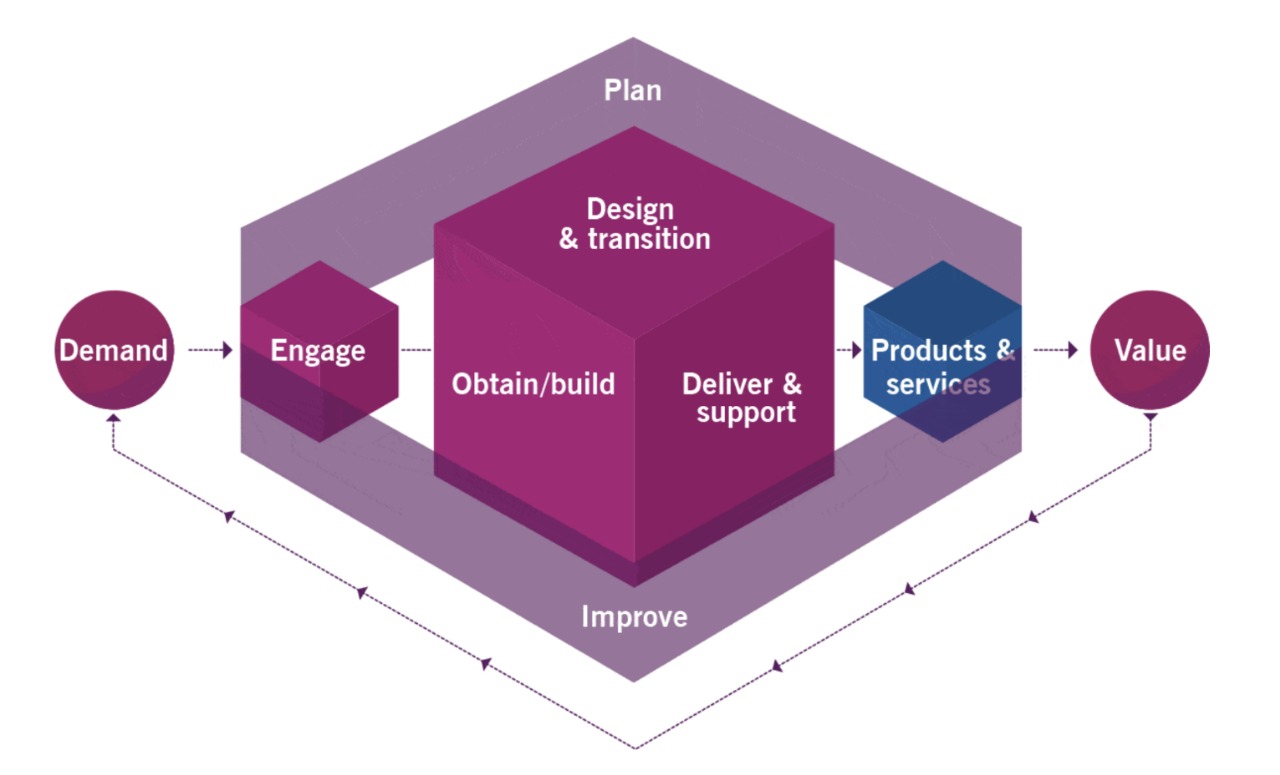
This week we moved from theory to practice. I analyzed some real-world cases using the Four Dimensions and Guiding Principles, walked through the Service Value Chain (SVC) from demand → value for an email-domain migration, created a mind-map of the Service Value System (SVS), and compiled a glossary of key ITIL terms. (Source: Week 3 class activity.)
Q1 — Linking Dimensions & Guiding Principles
This activity involves applying ITIL 4’s Four Dimensions of Service Management and the 7 Guiding Principles to two real-world cases:
Case 1: FAQ Chatbot giving irrelevant answers.
Case 2: Wi-Fi outage caused by vendor delays.
The goal is to understand how ITIL 4 concepts can be applied to practical problems. By identifying the relevant dimensions and guiding principles, I was able to see how these theoretical concepts help in analyzing and solving real-world IT service management challenges.
Case 1 — FAQ Chatbot gives irrelevant answers
- Primary Dimension: Information & Technology — Outdated knowledge base causes poor responses.
- Primary Principle: Progress Iteratively with Feedback — Ship small fixes, collect user/staff feedback, update content continuously.
- How they link: Iterative updates + feedback loops keep chatbot data accurate, current, and useful.
- Other Dimensions:
- Partners & Suppliers — coordinate with external data owners (admissions/scholarships).
- Value Streams & Processes — define roles, update cadence, and validation steps.
- Other Principles: Focus on Value, Collaborate and Promote Visibility, Keep It Simple and Practical. :contentReference[oaicite:1]{index=1}
Case 2 — University Wi-Fi outage from vendor delays
- Primary Dimension: Partners & Suppliers — dependency on vendor deliveries not mitigated.
- Primary Principle: Collaborate and Promote Visibility — transparent comms/SLA tracking to surface risks early.
- How they link: Strong vendor collaboration and visibility reduces service gaps and enables contingency plans.
- Other Dimensions:
- Value Streams & Processes — define vendor-risk process & contingency.
- Organizations & People — proactive comms to students during impact.
- Other Principles: Focus on Value, Think and Work Holistically, Optimize and Automate (status/ETA monitoring).
Q2 — Service Value Chain
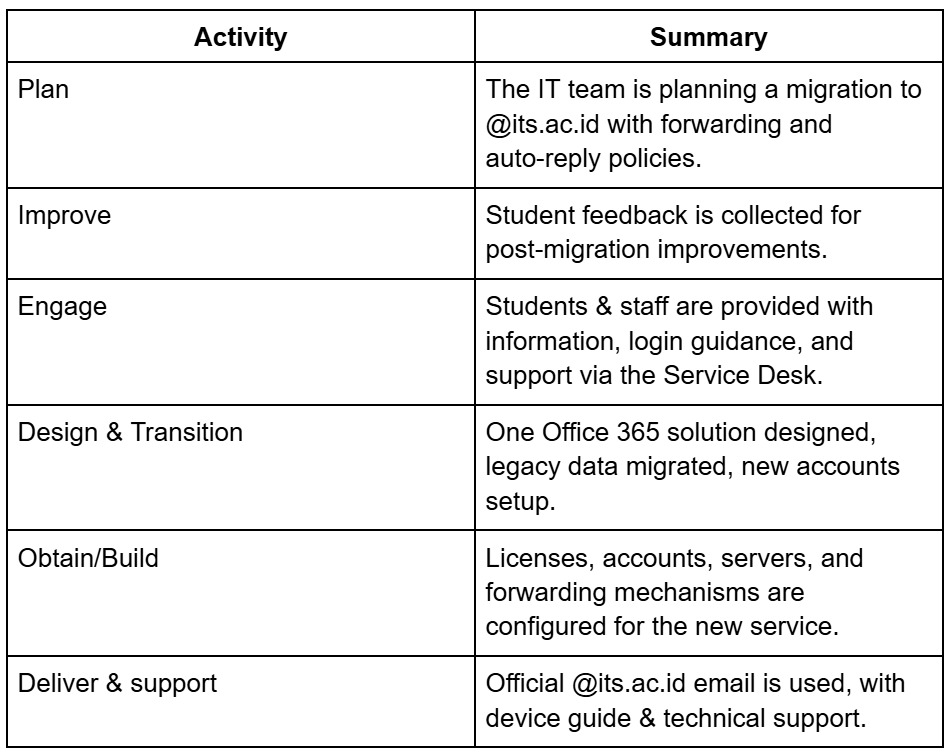
This activity involves walking through the Service Value Chain (SVC) to understand how a service moves from demand to value. I applied the SVC model to a university email migration project, from the initial demand for a new email system (consolidated, secure platform) to the delivered value (improved collaboration and access with Microsoft 365/Office 365).
Scenario: Migrate university email from @my.its.edu to @its.ac.id.
- Demand: One consolidated, secure platform to simplify access and collaboration.
- Value: Unified @its.ac.id accounts in Microsoft 365/Office 365 with improved collaboration, simpler access, and better UX.
SVC Activities
Q3 — Mind-Map of the Service Value System (SVS)
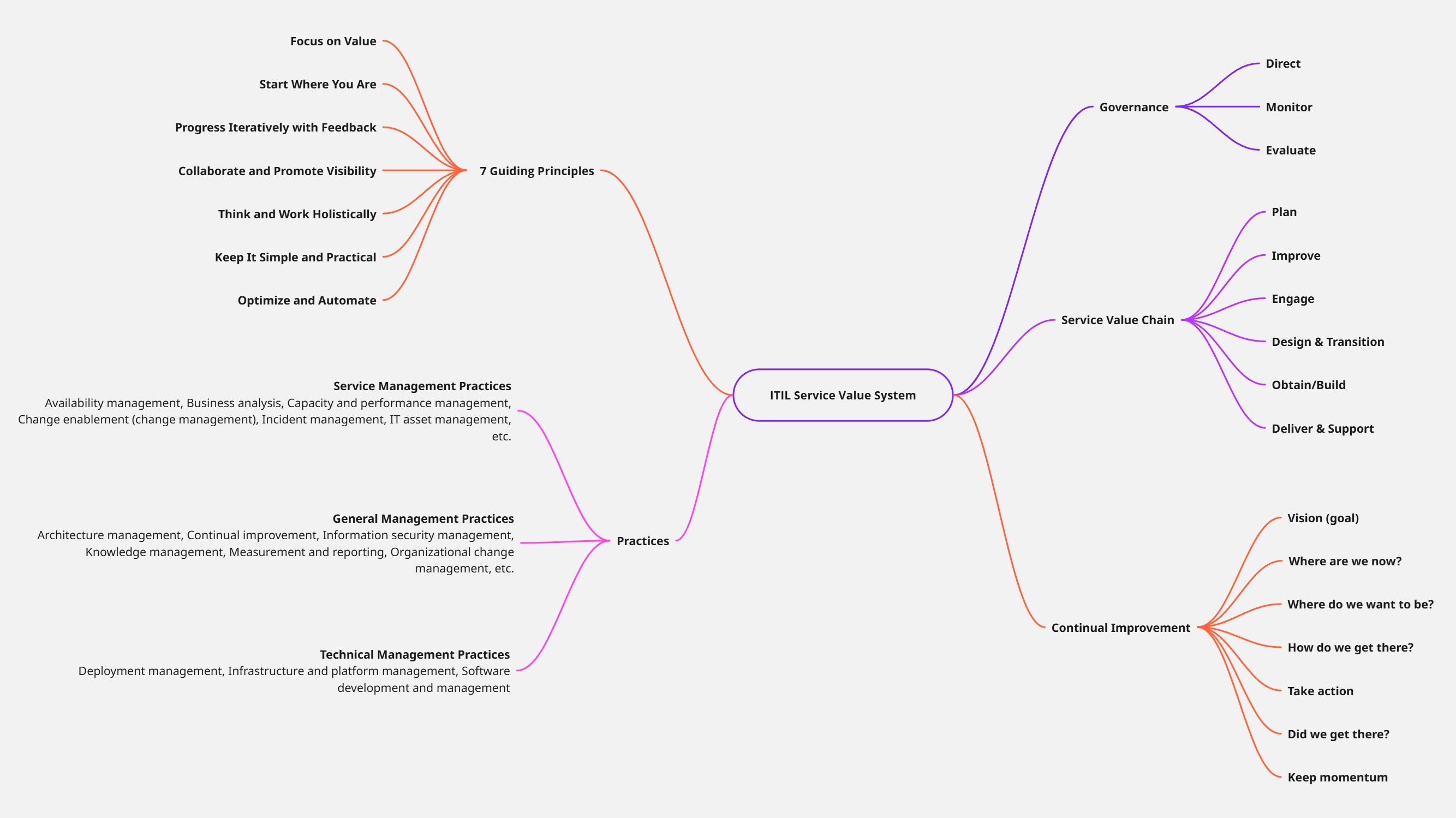
In this activity, I created a mind-map of the Service Value System (SVS) to visually organize and understand the components of ITIL 4 that enable value co-creation. The mind-map includes the 7 Guiding Principles, Service Value Chain, Practices, Governance, and Continual Improvement.
Q4 — ITIL Glossary Compilation
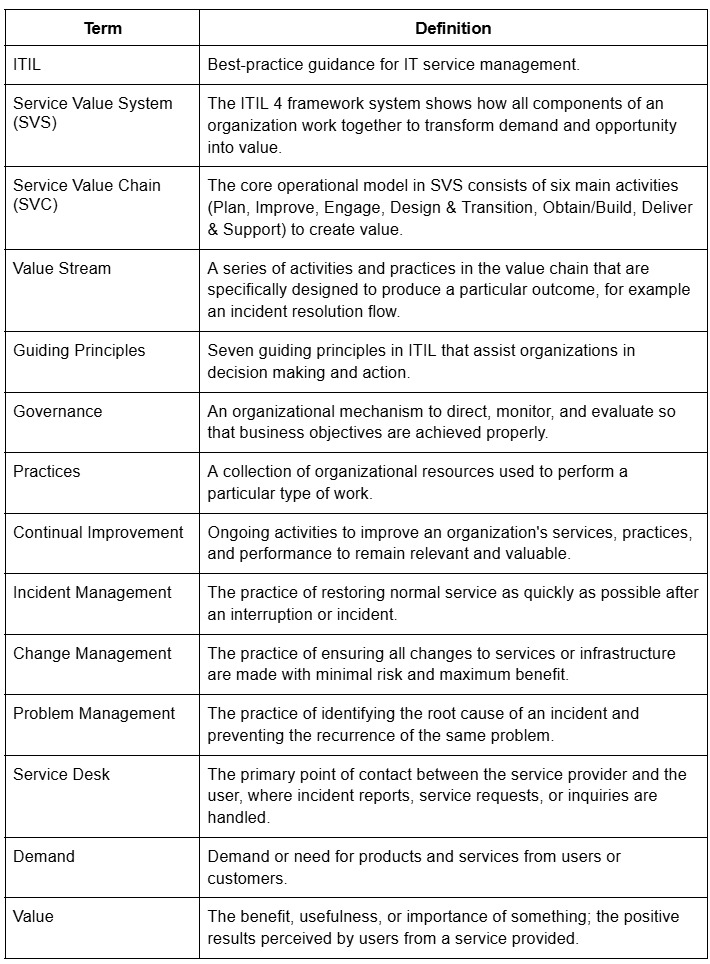
This activity involved compiling a glossary of key ITIL 4 terms to solidify my understanding of core concepts. The glossary provides definitions of terms such as Service Value System (SVS), Service Value Chain, Demand, and Value, helping to reinforce the vocabulary used in ITSM.
Reflection
The cases highlighted how dimensions and principles work together in practice: keeping knowledge bases current for a chatbot is as much about process ownership and feedback loops as it is about tech, while vendor-driven Wi-Fi upgrades demand visibility, clear SLAs, and end-to-end thinking. The SVC walkthrough reinforced how a clear plan, strong engagement, and smooth transition lead to real value for students and staff.